Du vil måske også synes om
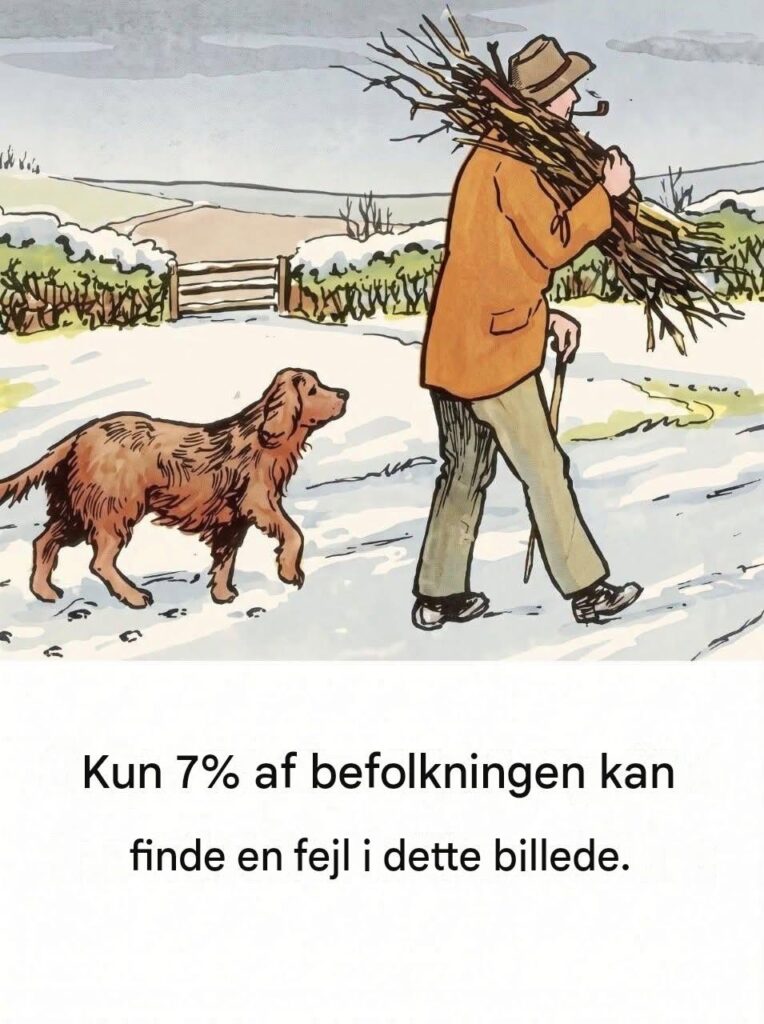
A beautiful winter landscape can seem perfectly ordinary at first glance. Snow-covered trees, frozen paths, distant hills, and a quiet blanket of white create a peaceful scene that feels almost magical. But what if something in the picture does not belong?
Visual puzzles like this have become popular because they challenge us to look beyond the obvious. At first, you might see nothing unusual. Then, after taking a closer look, you may notice a detail that makes the entire scene seem different.
The challenge is simple: Can you find the mistake in the snowy landscape? Before reading further, take a moment to examine the picture carefully. Look at the background, the snow, the trees, and the smaller details that might be easy to overlook.
Why Are Visual Spot-the-Mistake Puzzles So Challenging?
Our brains are designed to recognize familiar patterns quickly. When we look at a winter landscape, we automatically organize what we see into recognizable elements, such as trees, snow, mountains, and paths.
This ability helps us understand our surroundings, but it can also make visual puzzles surprisingly difficult.
When an image looks familiar, the brain may focus on the overall scene rather than examining every individual detail. As a result, something unusual can remain unnoticed even when it is clearly visible.
For example, a shadow might point in the wrong direction, an object might appear in an impossible position, or an element might not belong in a snowy environment.
The trick is to slow down and examine the image instead of relying entirely on your first impression.
Five Areas to Examine in the Winter Scene
If you are struggling to find the mistake, try dividing the picture into smaller sections.
1. Look at the trees.
Trees are common features in winter landscapes, but their branches can provide important clues. Examine their shapes, positions, and relationship to the surrounding scenery. Does anything look inconsistent?
2. Examine the snow.
Snow creates distinctive visual patterns. Look for unusual marks, unexpected colors, or objects that seem inconsistent with a snow-covered environment.
3. Check the shadows.
Light and shadows can reveal mistakes that are difficult to notice initially. If several objects cast shadows, consider whether the shadows appear consistent with the direction of the light.
4. Study the background.
People often concentrate on the largest objects in a picture and overlook the distant scenery. Mountains, buildings, trees, and the horizon may contain details that deserve a closer look.
5. Pay attention to unusual shapes.
Sometimes the mistake is not a completely foreign object but a familiar object that has been altered. A missing component, an incorrect shape, or an impossible arrangement can provide the clue you need.
Remember that these are general strategies for solving visual puzzles. Without examining the original image, it is not possible to confirm which specific detail is incorrect.
Why Do Our Brains Overlook Obvious Mistakes?
One interesting feature of visual perception is that seeing something does not always mean consciously noticing every detail.
When we concentrate on the overall meaning of an image, our attention becomes selective. We tend to prioritize the elements that seem most important and ignore information that appears less relevant.
This explains why two people can look at the same picture and notice completely different things.
One person might immediately identify an unusual object, while another focuses on the landscape’s colors or composition. Neither person necessarily has better eyesight; they may simply direct their attention differently.
Taking a short break and returning to the image can sometimes help. A fresh look may reveal details that were overlooked during the first attempt.
Can Picture Puzzles Improve Your Observation Skills?
Spot-the-mistake challenges provide an enjoyable way to practice concentration and visual attention.
They encourage you to compare details, recognize patterns, and consider whether different parts of an image make sense together. These activities can also be a relaxing break from everyday routines.
You can make the challenge more entertaining by sharing it with friends or family members. Ask everyone to examine the image independently and explain where they think the mistake is located.
Comparing answers can reveal how differently people interpret the same visual information.
However, solving these puzzles should not be treated as a formal test of intelligence or cognitive ability. Performance can depend on familiarity with the puzzle format, attention, and the specific visual details involved.
The Final Challenge: Did You Find the Mistake?
Before giving up, look at the snowy landscape one more time. Move your attention from the foreground to the background, compare similar objects, and look for anything that seems inconsistent with the rest of the scene.
Sometimes the answer is immediately obvious once someone points it out. Other times, the smallest detail is the one that makes the puzzle difficult.
The exact mistake in this particular picture cannot be confirmed from the article title alone. The original image is needed to identify the intended answer accurately rather than inventing a solution.
Upload the picture, and the unusual detail can be examined directly to determine what is wrong with the snowy landscape.