Du vil måske også synes om


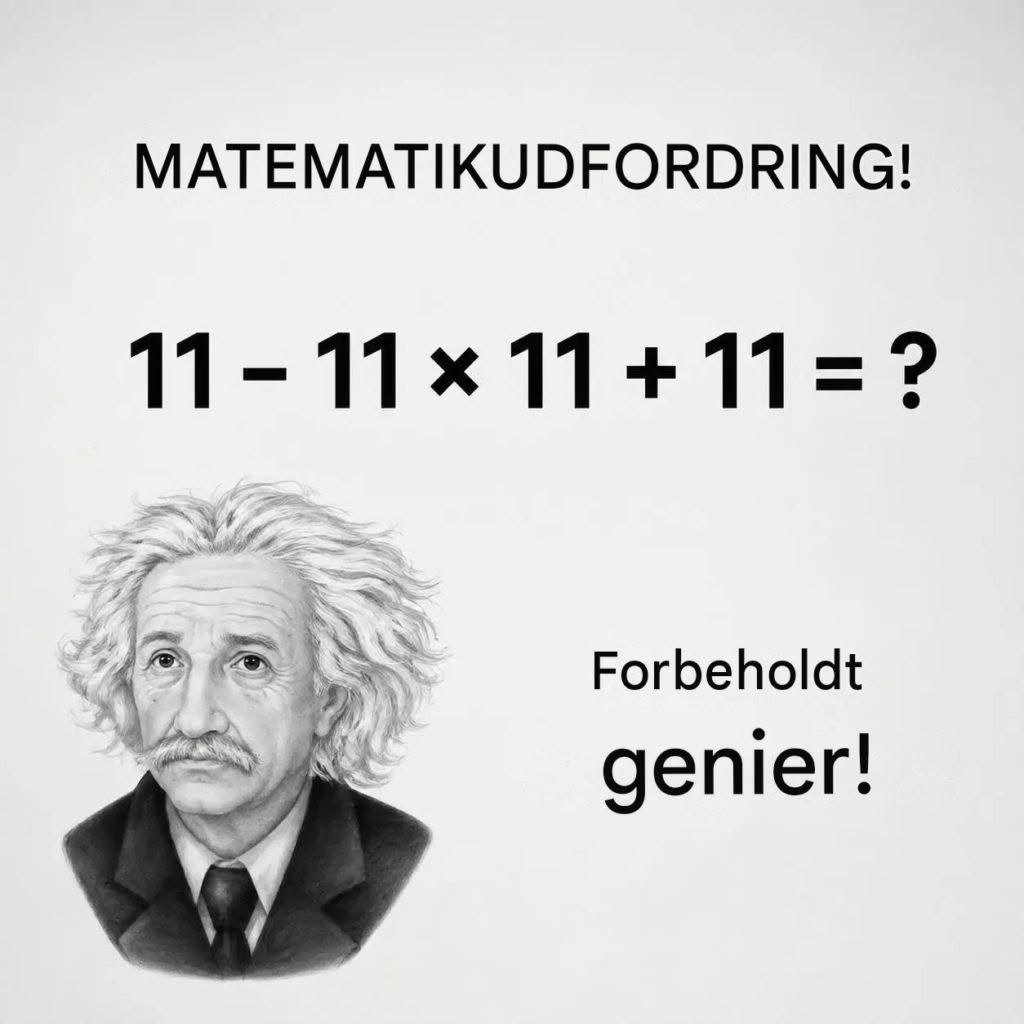
A simple math problem can sometimes be more challenging than it appears. With just four elevens and a few mathematical symbols, this puzzle tests whether you remember one of the most important rules in arithmetic.
At first glance, the calculation looks easy. There are no fractions, complicated formulas, or large numbers. Yet many people arrive at the wrong answer because they forget one crucial detail: the order of operations matters.
Before reading further, take a moment to solve the problem yourself. Try to do it mentally, without using a calculator.
Here Is the Math Challenge
Can you solve this equation?
Take a few seconds to think about your answer before continuing.
Some people start calculating from left to right, while others immediately recognize that multiplication must be handled first. The difference between these approaches determines whether the final answer is correct.
Why Do So Many People Get This Wrong?
When we read a sentence, our eyes naturally move from left to right. Without thinking, we sometimes apply the same habit to mathematical expressions.
For example, someone might begin by calculating 11 minus 11, which equals zero. They then continue with the remaining operations and arrive at an incorrect result.
The problem is not the numbers themselves. It is the assumption that every operation should be performed in the order it appears.
Mathematics follows a specific set of rules that determines which calculations must come first. Understanding these rules makes even tricky-looking equations much easier to solve.
The Important Rule You Need to Remember
To solve this puzzle correctly, you need to understand the standard order of operations.
Here is the usual sequence:
-
Parentheses: Calculate expressions inside parentheses first.
-
Exponents: Evaluate powers and roots where applicable.
-
Multiplication and division: Perform these operations from left to right.
-
Addition and subtraction: Perform these operations from left to right.
Multiplication does not always come before division, and addition does not always come before subtraction. Operations at the same level of priority are evaluated from left to right.
In this particular puzzle, multiplication must be completed before either subtraction or addition.
Step-by-Step Solution
Let’s return to the original equation:
Step 1: Perform the multiplication.
Calculate:
The equation now becomes:
Step 2: Calculate from left to right.
Subtraction and addition have equal priority, so we proceed from left to right.
First:
Then:
The correct answer is −99.
The key is to calculate the multiplication first rather than simply working through the equation from left to right.
How to Avoid This Mistake in the Future
One of the easiest ways to prevent errors is to pause before starting any calculation. Look at the entire expression and identify which operations have priority.
If multiplication, division, addition, and subtraction appear together, do not automatically begin with the first symbol. Check whether a higher-priority operation needs to be completed first.
It can also help to rewrite the expression after each step. This makes it easier to track your progress and reduces the chance of accidentally skipping a sign or changing a number.
These habits are useful not only for brain teasers but also for everyday calculations involving shopping discounts, household budgets, measurements, and percentages.
Can Simple Math Puzzles Keep Your Mind Active?
Short mathematical challenges provide an enjoyable opportunity to practise logical thinking, attention to detail, and problem-solving. They encourage you to slow down, question your first instinct, and apply a consistent method rather than relying on guesswork.
You can make these puzzles even more enjoyable by sharing them with friends or family members. Give everyone the same equation and ask them to solve it without a calculator. Comparing answers can lead to an interesting discussion about the rules behind the calculation.
Of course, one puzzle cannot guarantee improvements in memory or overall cognitive ability. However, mentally engaging activities can be a fun addition to an active and varied lifestyle.
Did You Get the Right Answer?
Now that you know the solution, think about how you approached the calculation. Did you remember to multiply first, or did you initially work from left to right?
If you answered −99, congratulations! You correctly applied the order of operations. If your first answer was different, don’t worry. This is a useful reminder that even simple equations require careful attention.
Share the puzzle with someone who enjoys a mathematical challenge and see whether they can find the correct answer without a calculator. Sometimes, the smallest calculations provide the biggest reminders about the importance of getting the basics right.